

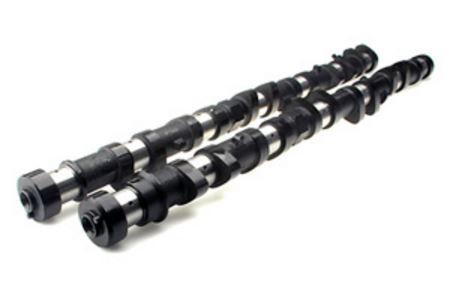
1JZ-GTE VVT-i Camshafts (by Brian Crower)
The third generation 1JZ-GTE was introduced around 1996 and, while still a 2.5-liter turbo, adopted Toyota’s BEAMS architecture. This included a reworked head, a newly developed continuously variable valve timing mechanism (VVT-i), improved water jackets for better cylinder cooling, and newly developed shims with titanium nitride coating to reduce cam friction. The turbo setup was changed from parallel twin-turbos (CT12A x 2) to a single turbo (CT15B). The single turbo is more efficient, partly due to the use of smaller exhaust ports in the head, which allow escaping exhaust gas to gain more velocity as it leaves the head, thereby spooling the turbo faster and at lower RPM. The adoption of VVT-i and improvements in cylinder cooling allowed the compression ratio to be increased from 8.5:1 to 9.0:1. Official power figures remain at 280 metric horsepower (210 kW) at 6200 rpm, but torque increased by 20 Nm to 379 Newton-meters (280 lb-ft) at 2400 rpm. These improvements increased engine efficiency, resulting in a 10% reduction in fuel consumption. The adoption of a single turbocharger, which is far more efficient than the twin setup, along with different manifolds and exhaust ports, accounted for most of the 50% increase in torque at low engine speeds. This engine was primarily used in Toyota's X-chassis cars (Chaser, Mark II, Cresta, Verossa), the Crown Athlete V (JZS170), and the later JZZ30 Soarer, as the JZA70 Supra had long been discontinued by this time.
BC0334 : Street/Strip Spec
- Plug and play application. Short duration for nice street manners and a slight lope at idle. Excellent for all-purpose use. OEM spring OK.
BC0334 : Street/Strip Spec
- Longer duration profile with additional RPM potential. Designed for a fully built engine. Tuning and ECU modifications are recommended. Requires kit BC0300.
Applications
- 1JZ-GTE VVT-i Platform
What's in the box?
- Both intake and exhaust cams