


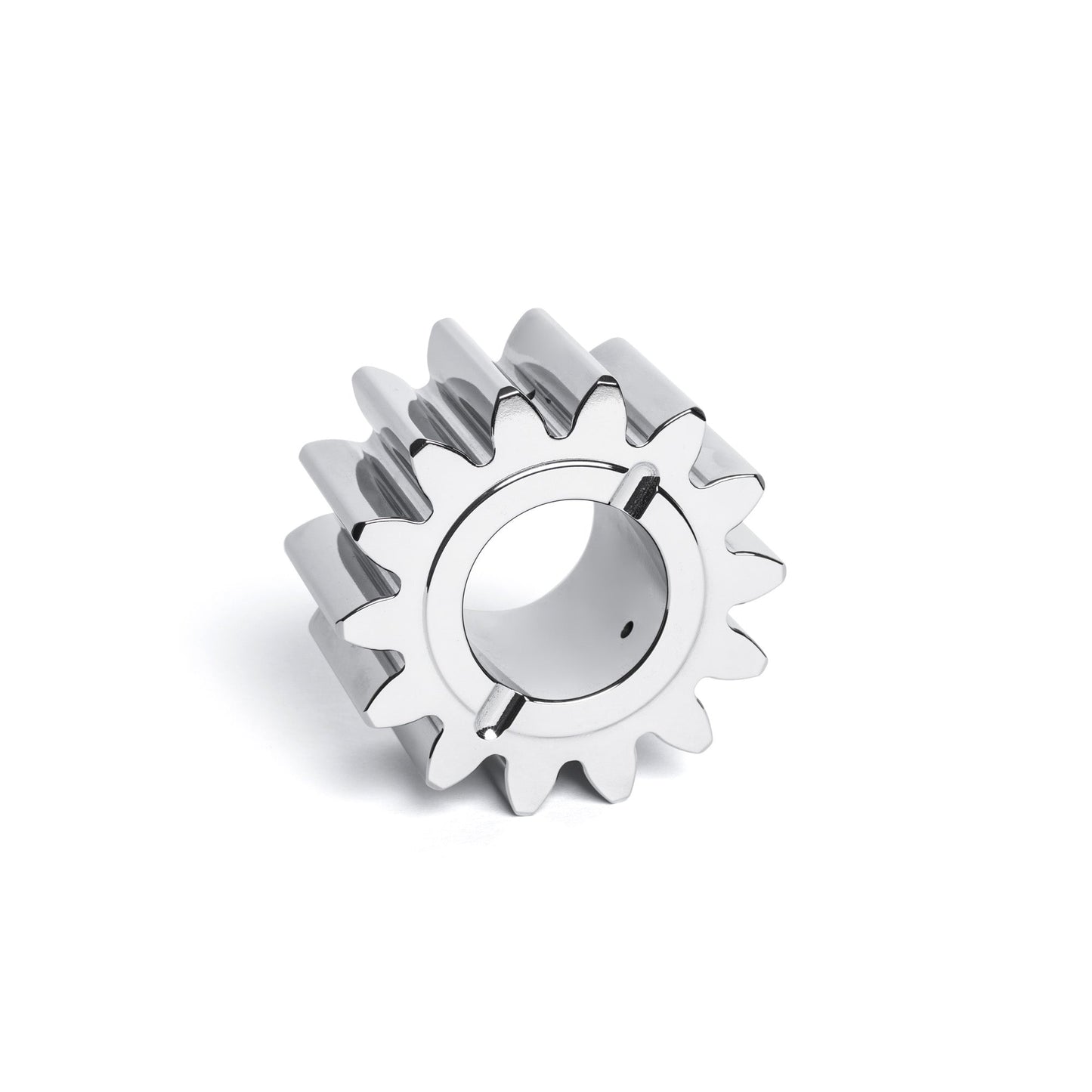
Our spools are meticulously crafted from 4140 chromoly billet material and machined to precise tolerances, ensuring that your wheels remain locked at all times. They are ideal for drag or drift applications where equal torque must be applied to both rear wheels to optimize acceleration potential.
Unlike standard or mechanical LSDs, which can fail or crack under the stress of motorsport use, our spools offer superior durability.
Weighing in at less than 5 kg, these units offer significant performance benefits. Reduced weight means less force is required to rotate the mass, resulting in faster times at the strip and reduced drivetrain wear.
Designed to fit the open-wheel Nissan R200V differential common in models such as the 350Z, 370Z, G35/V35 Skyline, and similar vehicles, these spools feature a 31-spline configuration and are compatible with both open-wheel and LSD shafts due to the robust full-spool design where the splines run from end to end.
After manufacturing, the spools are nitrided for increased durability.
What is nitriding? A heat-treating process that diffuses nitrogen into the surface of a metal to create a case-hardened surface. These processes are most commonly used on low-carbon, low-alloy steels. They are also used on medium-carbon steels, high-carbon steels, titanium, aluminum, and molybdenum.
Designed and machined by Speedtek Auto Racing.
Isotropic superfinishing now standard on all Speedtek products.
(This process adds time to the shipping of your kit; please email us if you have any questions)
Superfinishing is a metalworking process that improves the surface finish and geometry of a workpiece. It is achieved by removing only the thin, amorphous surface layer left by the last process using abrasive stones to polish gears and other components. This layer is typically about 1 μm in size. Unlike polishing, which creates a mirror finish, superfinishing creates a cross-hatch pattern on the workpiece.
Benefits of superfinishing include extended component life, reduced wear, tighter tolerances, improved load-bearing surfaces, enhanced sealing capabilities, and the elimination of break-in periods.